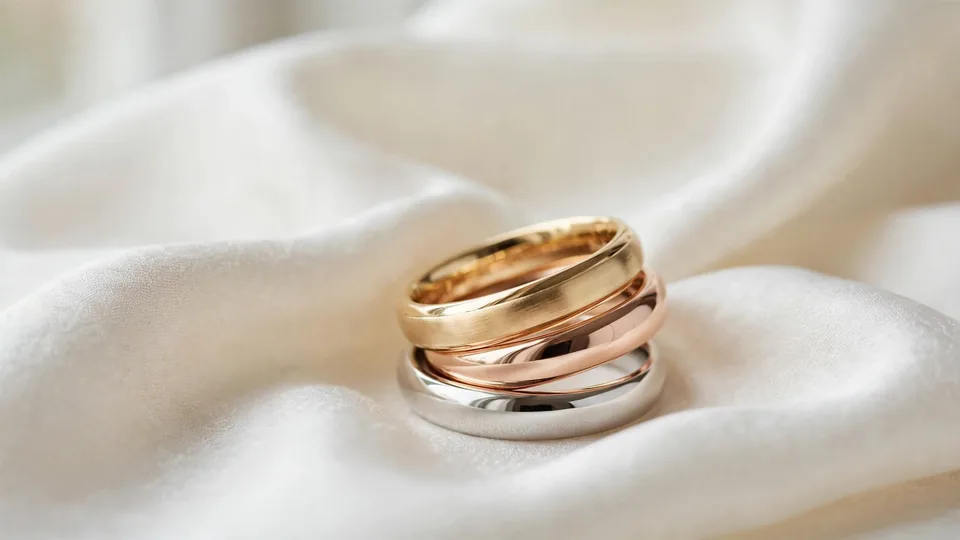
A mixed metal wedding rings stack pairs bands in two or more gold tones — typically yellow, rose and white gold — layered together on one finger. This two-tone approach lets you mix your engagement ring metal with contrasting wedding bands for a curated, modern bridal look that flatters every skin tone.
Whether you blend a yellow gold heirloom band with a white gold engagement ring or build an entire stack from scratch, mixed metal wedding ring stacks let you break the old matching rules. Below are 18 mixed metal wedding rings stack ideas — from delicate micro-bands to bold two-tone statements — each a distinct angle to help you design a stack that is unmistakably yours.
One styling note before we dive in: repeat each metal at least twice across the stack, vary textures and widths, and let one metal take the lead so the combination reads intentional rather than accidental.
1. The Classic Trio: Yellow, Rose & White Gold Stack
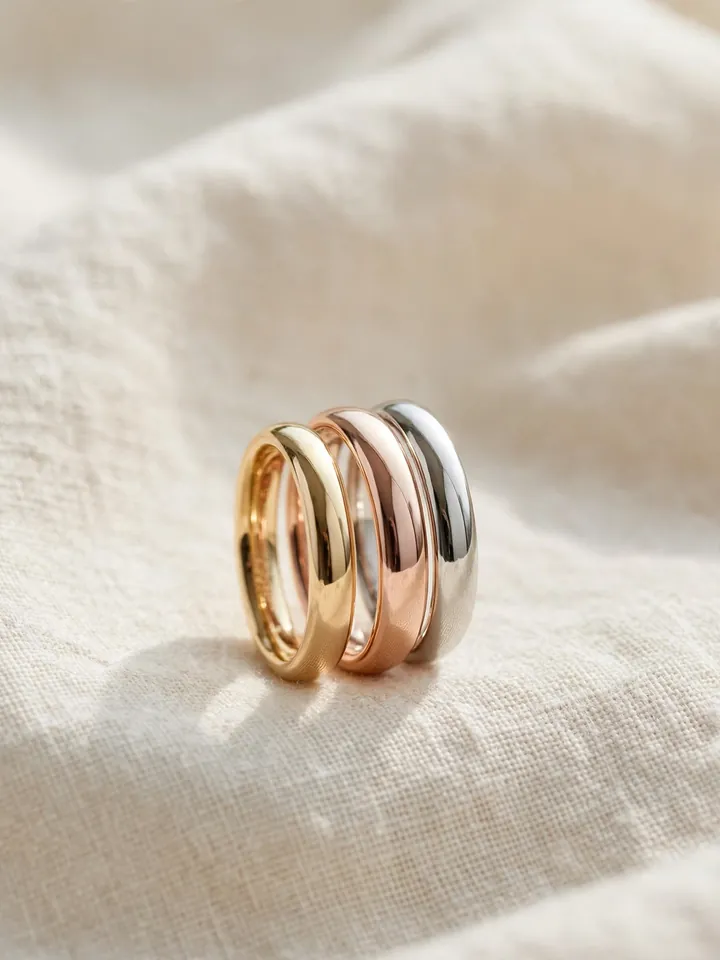
The most iconic mixed metal wedding rings stack starts with the timeless trinity: one yellow gold band, one rose gold band and one white gold band, all in the same simple profile.
Keep the widths identical — around 1.8 to 2.2mm each — for a polished, symmetrical look, or vary them slightly for a more organic feel. Polished finishes reflect the most light and make the colour contrast pop, which is ideal if you want the mixed metals to read clearly from across the room.
Wear the trio together daily, or split it across hands: engagement ring with one band on your left hand, the remaining two stacked on your right. Because each band is a standalone classic, you will reach for them individually for years. It is the mixed metal wedding rings stack equivalent of a capsule wardrobe — minimal pieces, endless combinations.
2. Two-Tone Engagement Ring Paired with a Mixed Metal Wedding Band
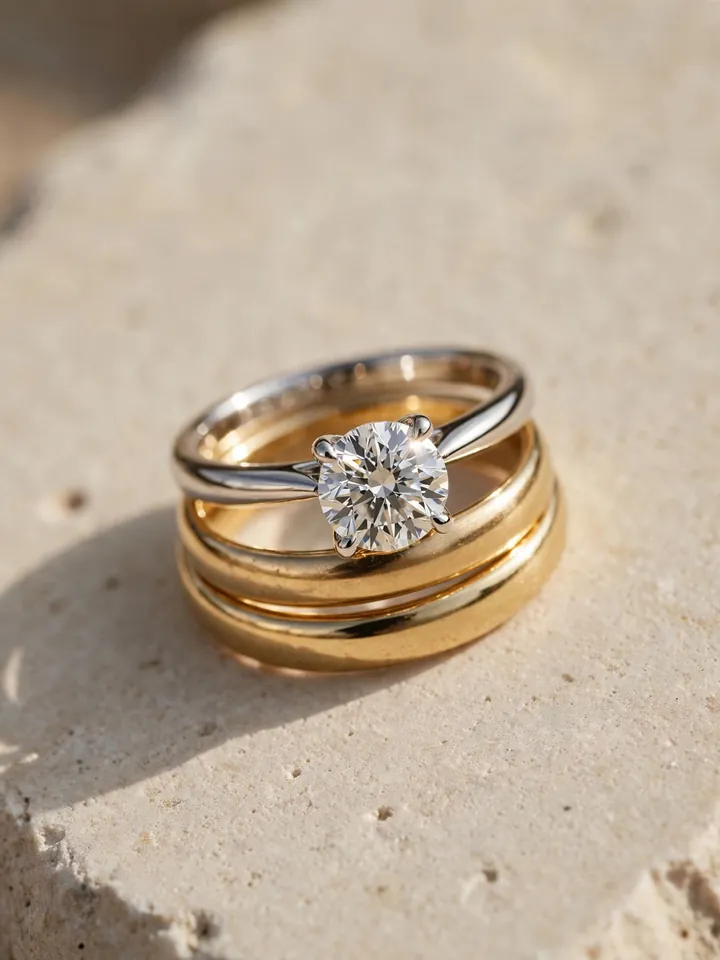
If you already own an engagement ring, you do not need to buy a matching band. One of the easiest mixed metal wedding rings stack ideas is to pair your existing ring with a wedding band in a deliberately different metal. A white gold or platinum solitaire next to a warm yellow gold band creates instant contrast that looks intentional and modern rather than mismatched.
Jewellers call this “bridging metals,” and it is the reason so many stylists recommend repeating your band metal somewhere else in your outfit.
When ring shopping, bring your engagement ring with you and try bands in every metal against it in natural daylight. You will be surprised how often the “wrong” metal is the right one. Ask for a low-profile band that sits flush, and the two rings will read as a single curated mixed metal wedding rings stack.
3. Curved Contour Bands Hugging Your Solitaire
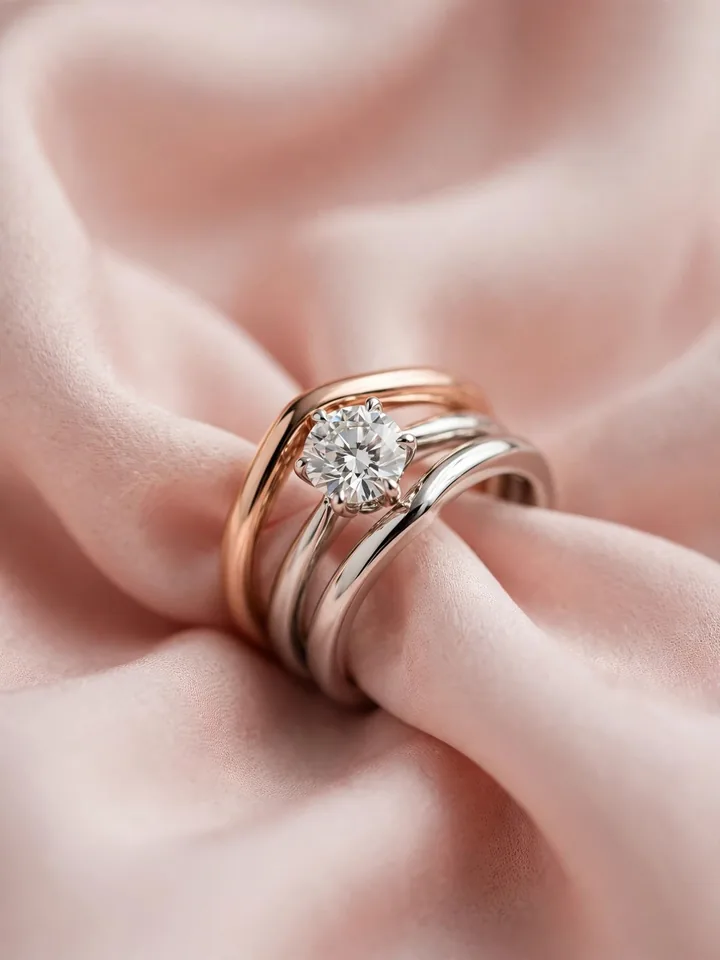
Curved or contour wedding bands are shaped to nestle against the raised setting of a solitaire, eliminating the awkward gap that straight bands leave. In a mixed metal wedding rings stack, a curved band in a contrasting metal becomes a design feature rather than a compromise — the sweep of rose gold cradling a white gold solitaire is pure jewellery architecture.
The curve draws the eye around the finger, making the stack feel sculptural and custom even when the bands are stock pieces.
Order contour bands to match your exact setting height — too shallow and the band will not touch the ring; too deep and it will rock. A good bench jeweller can custom-bend a stock band for a modest fee. Once fitted, this mixed metal wedding rings stack sits as one seamless, gap-free unit that never spins.
4. Chevron & V-Shaped Bands for a Geometric Stack
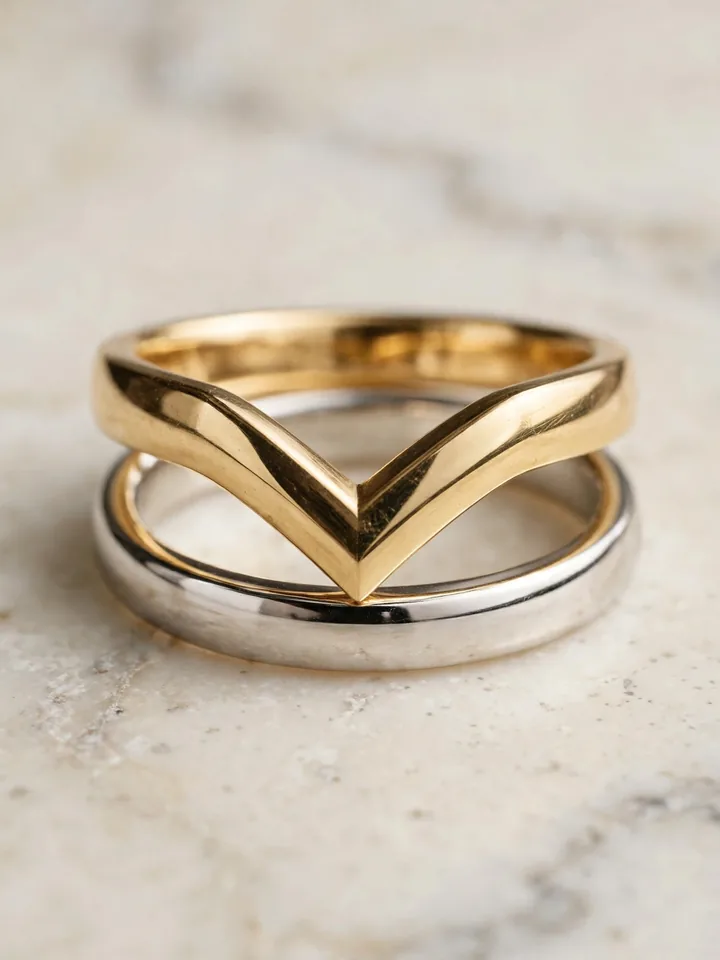
Chevron and V-shaped bands bring graphic, architectural energy to a mixed metal wedding rings stack. The pointed silhouette creates a visual arrow toward the centre stone, and when the chevron is struck in a contrasting metal — say yellow gold against white gold — the geometry becomes the star of the stack. It is a favourite among brides who love modern, editorial jewellery.
A single chevron band stacked with two straight bands gives you asymmetry without chaos; two mirrored chevrons framing the engagement ring create a bold, symmetrical statement.
Size chevron bands a quarter-size up, since the angled profile sits tighter across the knuckle than a round band. Pair polished chevrons with matte straight bands to let the shape shine, or keep everything polished for maximum graphic impact. Either way, this mixed metal wedding rings stack reads confident and contemporary.
5. Pavé Eternity Bands in Alternating Metals
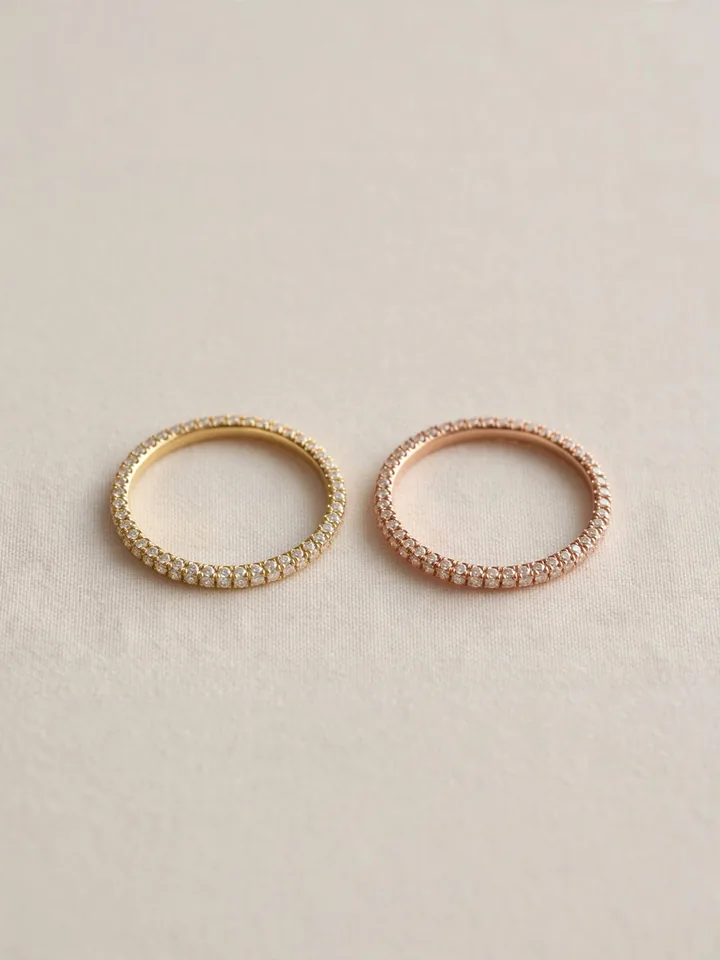
Pavé eternity bands — rings encircled entirely with small diamonds — are the sparkle engines of any mixed metal wedding rings stack. Alternating the metal between bands, such as a yellow gold pavé eternity stacked with a rose gold one, multiplies the light play: each metal reflects a slightly different warmth, so the diamonds flash in layered tones rather than a single flat white.
Eternity bands are also the most versatile stackers because they look identical from every angle — no spinning, no “top” to keep upright.
Choose shared-prong or French pavé settings for the smoothest feel against neighbouring bands, and keep the diamond size under 2mm per stone so the bands stay comfortable for daily wear. Full eternity bands cannot be resized, so confirm your size across seasons before committing. Done right, this mixed metal wedding rings stack delivers maximum brilliance with zero fuss.
6. The Micro-Band Stack: Five Whisper-Thin Rings
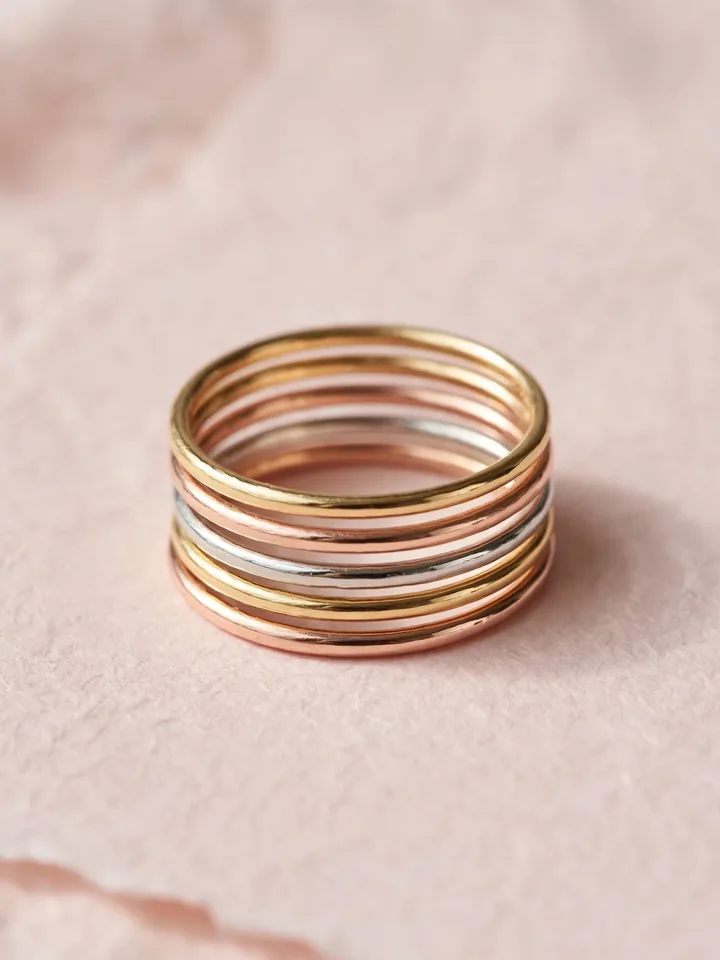
Micro-bands — rings under 1.5mm wide — let you stack five or more pieces without bulk, making them perfect for a maximalist mixed metal wedding rings stack that still feels delicate. Alternate yellow, rose and white gold in a repeating pattern, and the hairline stripes of colour create a fine, almost textile-like effect on the finger.
The beauty of micro-bands is modularity: add a new band for each anniversary, a birth, or a milestone, and the stack becomes a wearable timeline.
Stack micro-bands in odd numbers — three, five, seven — for the most pleasing composition, and consider a slightly wider “anchor” band at the base to ground the stack. This mixed metal wedding rings stack is ideal for brides with petite fingers or active lifestyles, since the low profile never snags and the weight stays featherlight.
7. Bold & Wide Mixed Metal Bands
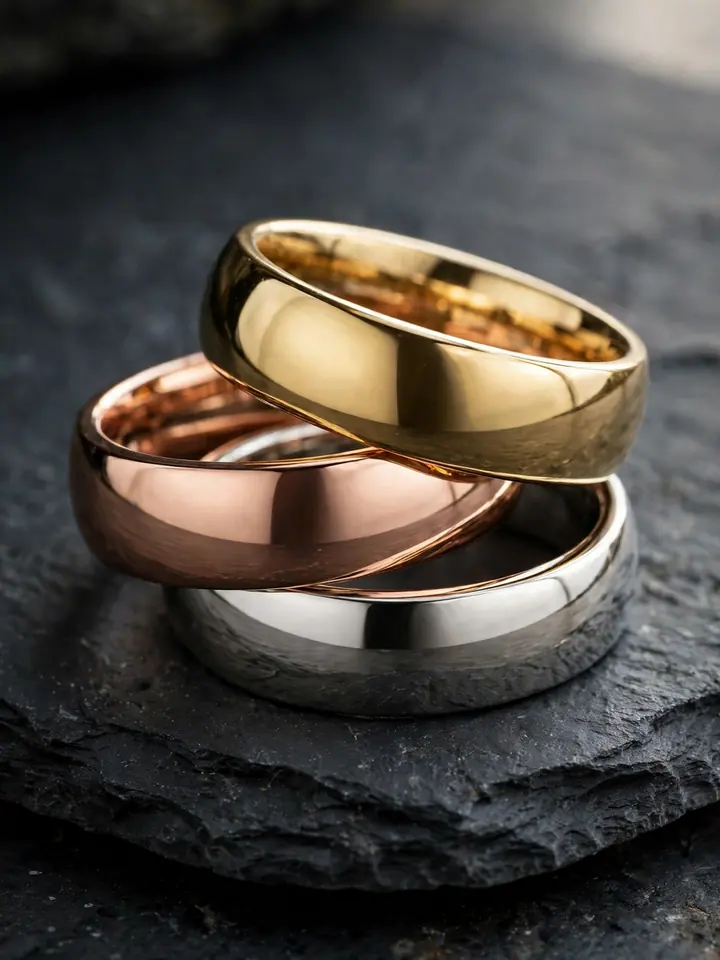
On the opposite end of the spectrum, wide bands — 4mm and up — turn a mixed metal wedding rings stack into a statement. A trio of substantial bands in yellow, rose and white gold has the presence of a cuff bracelet shrunk to finger scale, and the broad metal surfaces show off each tone’s colour with gallery-like clarity.
Wide bands demand comfort-fit interiors with domed inner profiles, so try them on and wear them around the jeweller’s shop before deciding.
This is the mixed metal wedding rings stack for brides who love bold jewellery and want their wedding set to hold its own next to a statement watch or chunky bracelet. Keep the finishes polished or softly brushed — high-polish wide bands show scratches fastest, so a brushed finish is the practical luxury choice for daily wear.
8. Rose Gold + White Gold Romantic Pairing
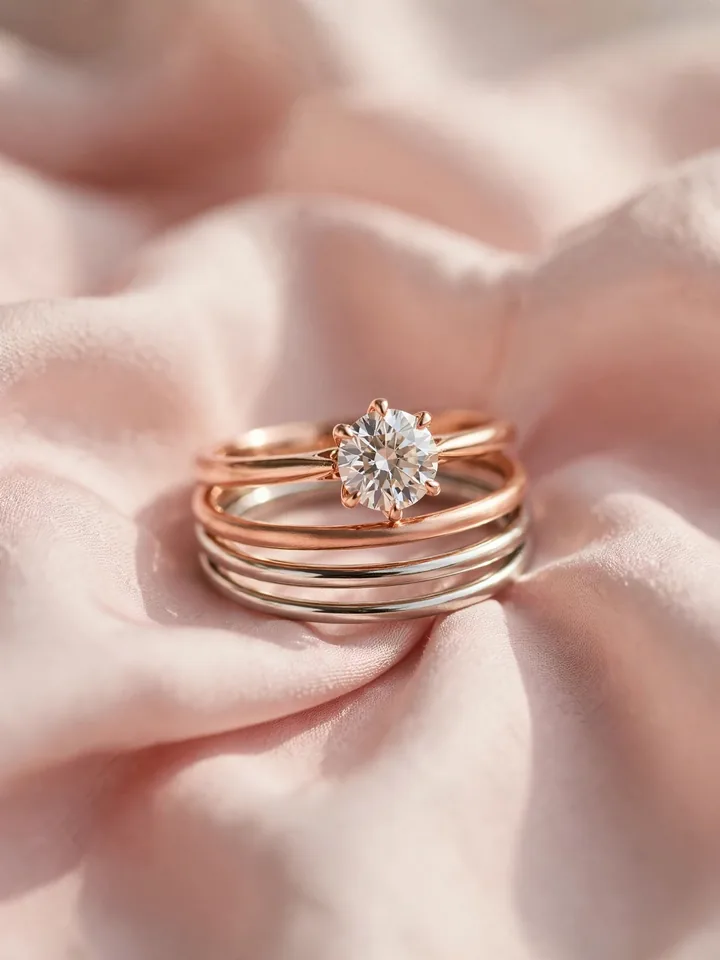
Rose gold and white gold are the romantic duo of the mixed metal wedding rings stack world. The blush warmth of rose gold softens the icy crispness of white gold, creating a combination that feels feminine, modern and endlessly wearable. It flatters fair to medium skin tones beautifully and photographs with a dreamy, editorial glow.
Try a rose gold diamond engagement ring stacked with alternating white gold and rose gold bands, or flip the script with a white gold solitaire framed by rose gold. Add a single pavé band for sparkle, keeping the diamonds small so the metal colours stay the hero.
For brides who want a mixed metal wedding rings stack that feels like an extension of their personal style rather than a trend, rose plus white is the sweet spot.
9. Yellow Gold + Platinum Statement Stack
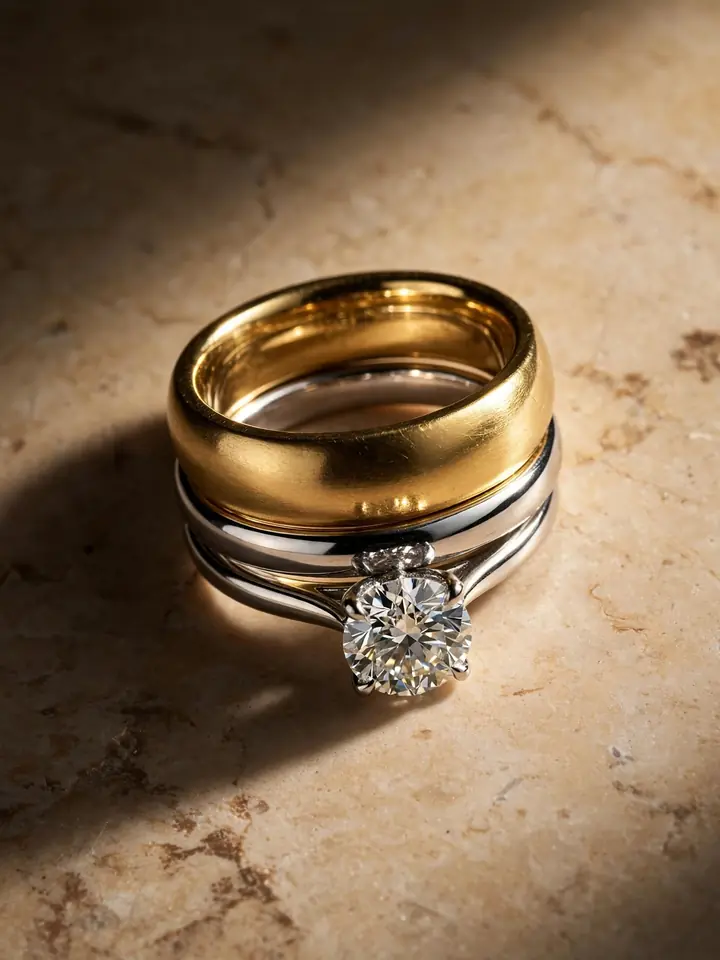
For maximum contrast, pair the warmest metal with the coolest: yellow gold against platinum. This high-drama mixed metal wedding rings stack plays the rich, sunny depth of 18k yellow gold off platinum’s steely white lustre, and the tension between them is pure luxury. It is the combination favoured by collectors and vintage dealers for a reason.
Platinum’s density gives bands a satisfying heft that balances yellow gold’s visual warmth, so a platinum wedding band next to a yellow gold engagement ring feels substantial and grounded.
Keep the profiles simple — platinum shows its quality in weight and finish rather than ornament — and let the metal contrast do the talking. A yellow gold solitaire, a platinum pavé band and a plain yellow gold spacer is a complete, gallery-worthy mixed metal wedding rings stack that will never date.
10. The Complete Trio: Engagement, Wedding & Anniversary Bands
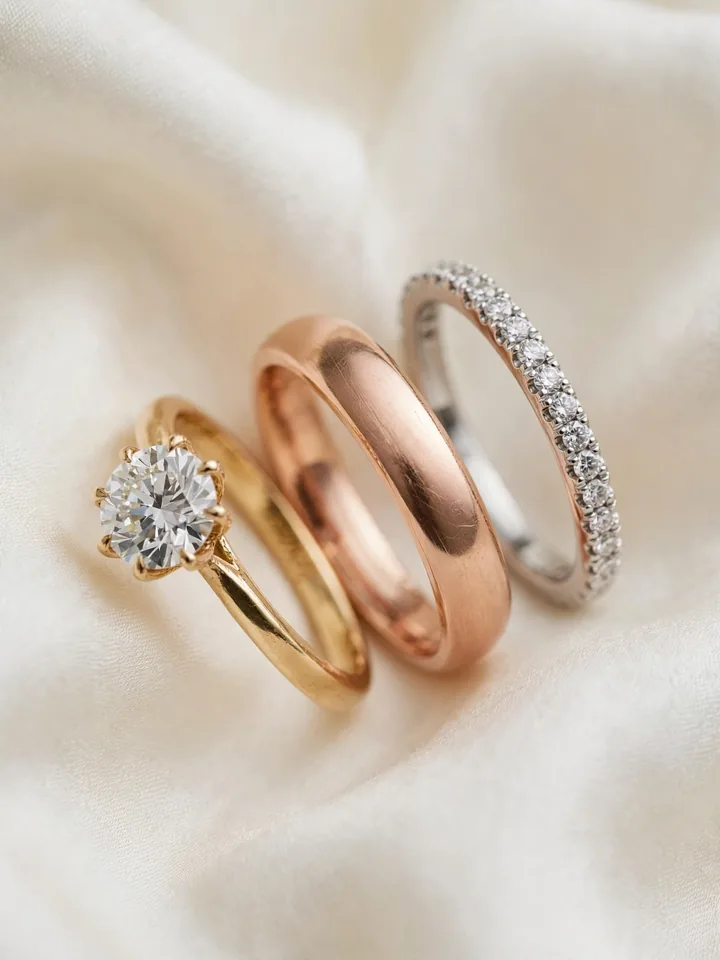
Think of your mixed metal wedding rings stack as a three-act story: the engagement ring that started it, the wedding band from the ceremony, and an anniversary band marking the years since. Assigning each chapter its own metal — white gold for the engagement ring, yellow gold for the wedding band, rose gold for the anniversary band — turns the stack into a narrative you wear.
This approach takes the pressure off matching everything at purchase. Buy the best engagement ring you love now, choose a wedding band that complements it, and let the anniversary band be a future gift that introduces the third metal. Each addition is a celebration rather than a compromise, and the mixed metals make the evolving stack look intentional from day one.
Plan the metals loosely in advance so the final trio balances — if the first two rings are both warm tones, reserve a cool metal for the anniversary band.
11. Nesting Bands for Oval & Asymmetric Stones
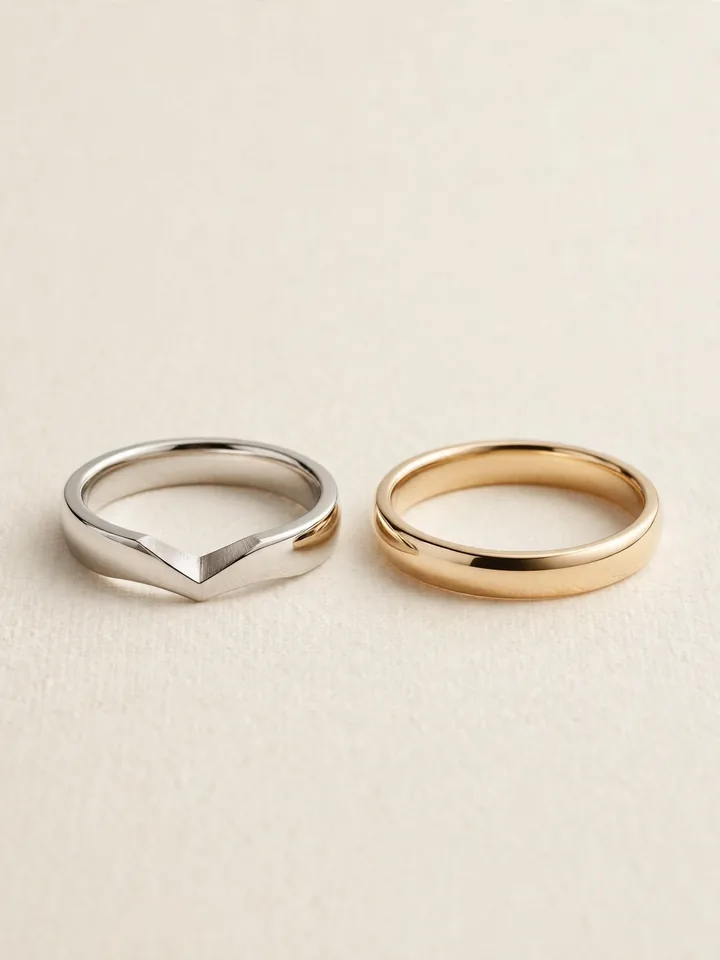
Oval, pear and marquise engagement rings sit higher and wider than round solitaires, so standard straight bands leave visible gaps. Notched nesting bands — with a curved cut-out that cradles the stone’s silhouette — solve the problem elegantly, and in mixed metals the notch becomes a frame that spotlights the centre stone.
A white gold nesting band hugging a yellow gold oval solitaire, for example, outlines the stone in cool metal while the warm shank glows beneath — the mixed metal wedding rings stack equivalent of matting a painting.
Because nesting bands are cut for a specific stone shape, buy them as a set with the engagement ring or have them custom-notched by a bench jeweller. Once fitted, the rings lock together and wear as one sculptural unit. This is the most bespoke-feeling mixed metal wedding rings stack on the list without commissioning fully custom pieces.
12. Hammered & Textured Organic Bands
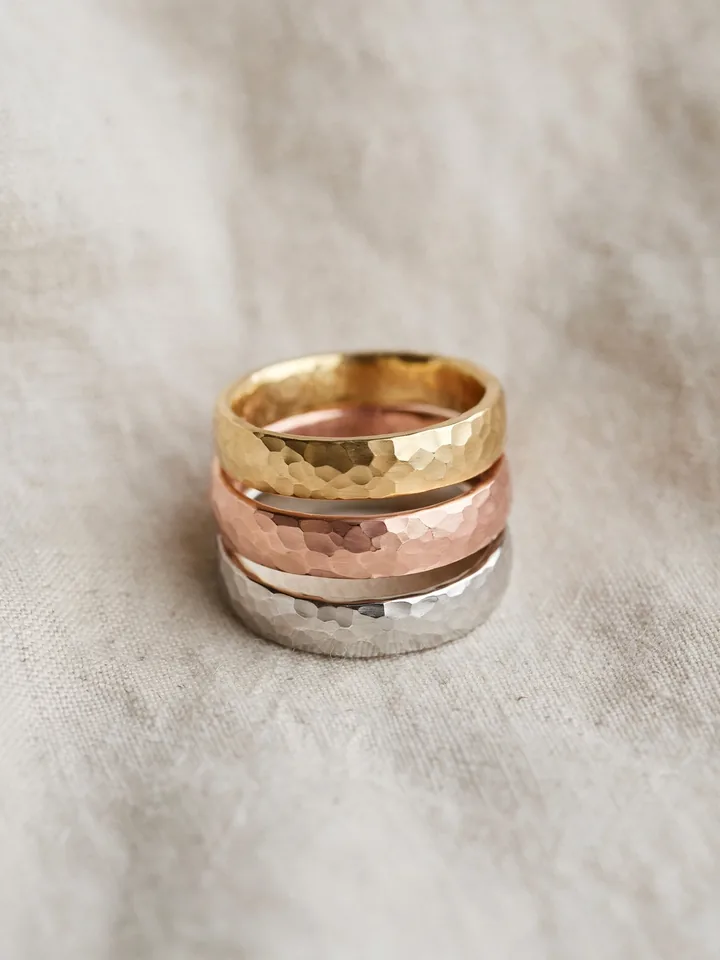
Hammered, brushed and bark-textured bands bring an artisanal, organic dimension to a mixed metal wedding rings stack. Texture breaks up light differently on each metal — hammered yellow gold glows, hammered white gold shimmers — so a stack of textured bands in mixed metals has a hand-forged richness that polished rings cannot replicate.
Mix textures deliberately: one hammered band, one high-polish band, one matte brushed band, each in a different metal. The contrast of finish is as important as the contrast of colour, and it keeps a multi-band stack from looking busy.
This mixed metal wedding rings stack suits bohemian, nature-inspired and minimalist weddings alike — it reads as jewellery with a human touch. Pair with an unadorned solitaire or a rough-cut stone for the full organic story, and the stack will look as good at year twenty as on day one.
13. The Blackened Gold Accent Band
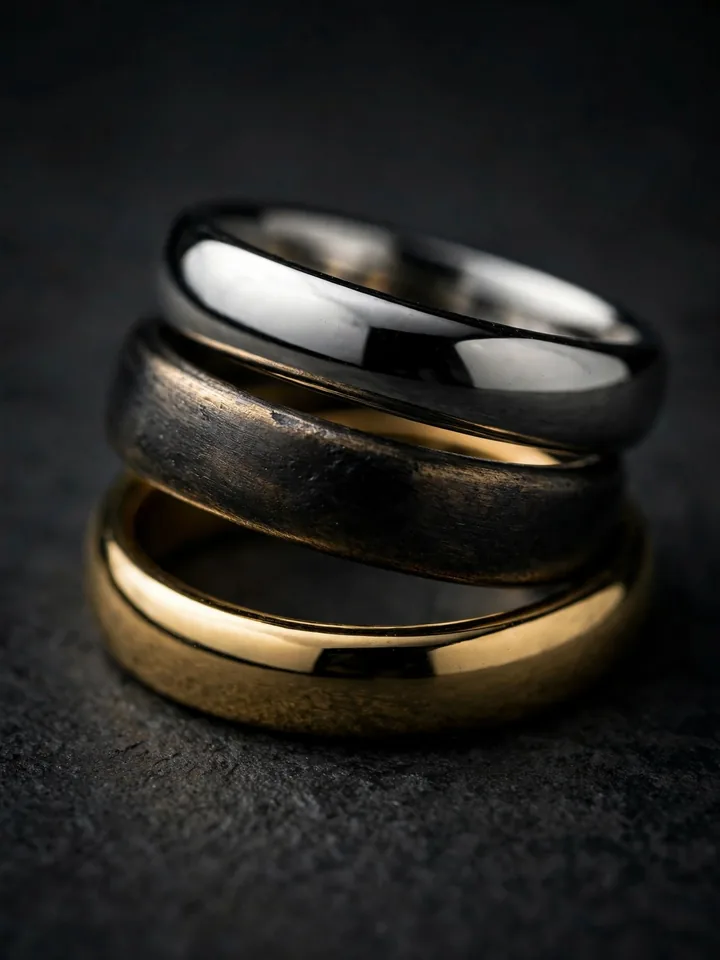
A single blackened gold or black rhodium band is the wildcard that makes a mixed metal wedding rings stack unforgettable. The dark accent acts like eyeliner for the stack — a thin line of contrast that sharpens the warm yellows and cool whites around it and gives the whole composition a fashion-forward edge.
Keep the blackened band slim (1.5 to 2mm) and sandwich it between two polished bands so it reads as a deliberate stripe rather than a mourning ring. It is a favourite among brides with modern, architectural personal style.
Note that blackened finishes wear over time, gradually revealing the gold beneath at contact points — many wearers love this evolving patina, but if you want the black to stay crisp, plan for periodic re-blackening. As the rebellious accent in your mixed metal wedding rings stack, a little evolution only adds character.
14. Milgrain & Vintage-Inspired Mixed Metal Stack
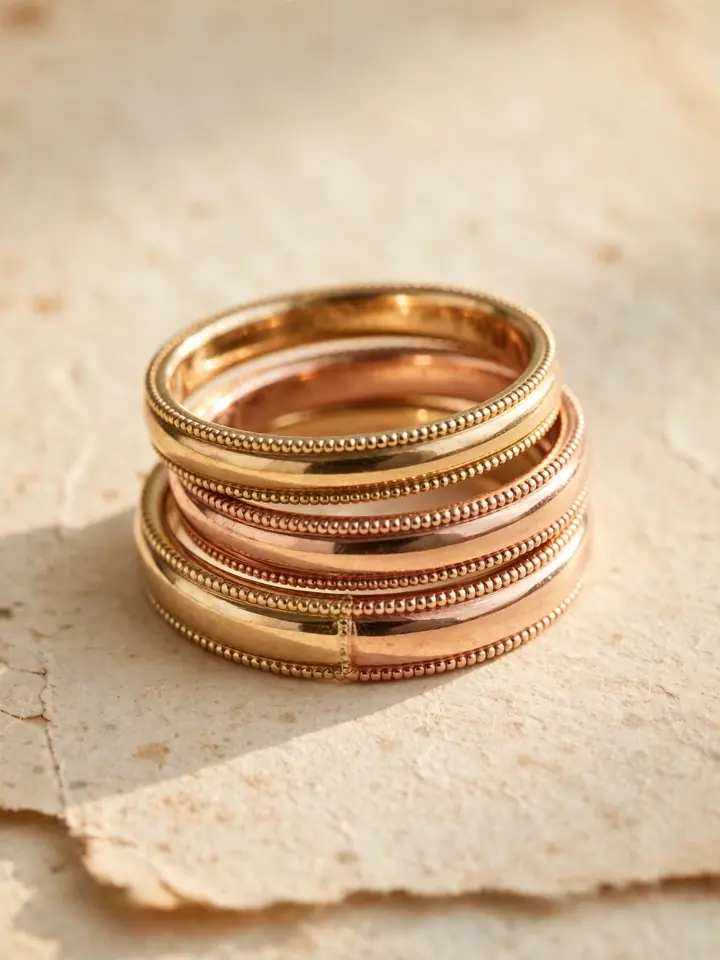
Milgrain — the tiny beaded edging borrowed from Edwardian and Art Deco jewellery — gives a mixed metal wedding rings stack instant heirloom character. A milgrain-edged band in yellow gold stacked with a rose gold partner whispers vintage romance while the mixed metals keep it firmly in the present day.
Build the stack around one genuinely vintage or vintage-style ring, then add contemporary bands in contrasting metals to prevent the look from becoming costume. The fine milgrain beading catches light at the edges, outlining each band so the metal colours stay distinct even in slim profiles.
This mixed metal wedding rings stack is made for brides marrying in historic venues, wearing vintage gowns, or inheriting a grandmother’s ring. The old-meets-new metal mix tells a story of continuity — the past and the present, literally bound together on one finger.
15. Birthstone Accents in Your Mixed Metal Stack
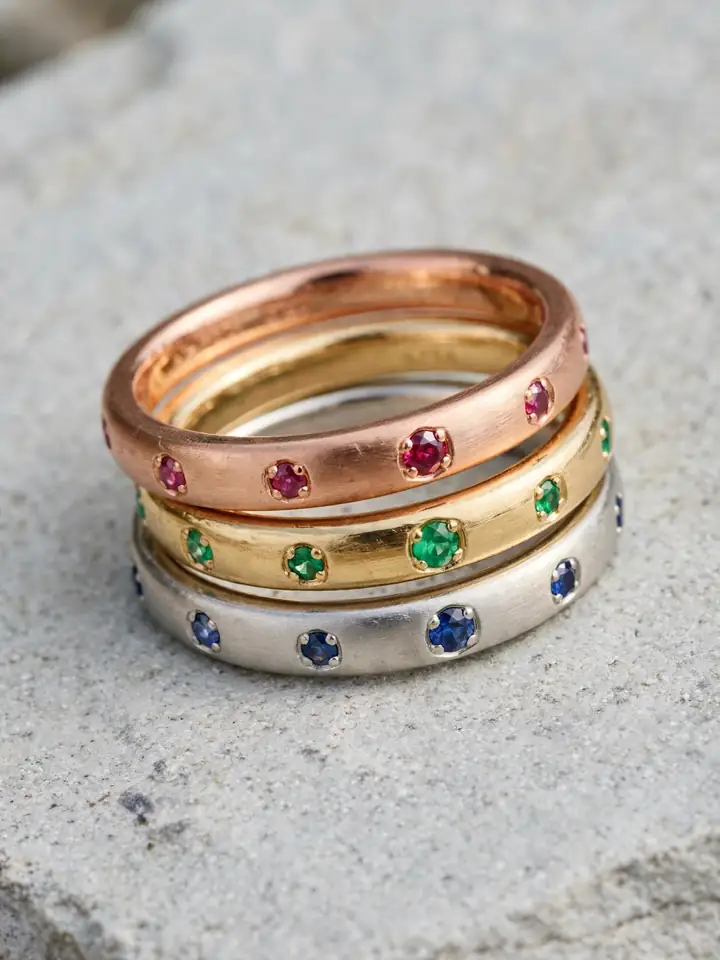
Weave birthstones into your mixed metal wedding rings stack for a layer of personal meaning. A slim band set with your birthstone — or your partner’s, or a future child’s — in a metal that contrasts the rest of the stack turns the jewellery into a family portrait. Sapphires glow against yellow gold, emeralds deepen beside rose gold, and rubies ignite next to white gold.
Keep the stones small (2mm or under) and bezel-set for durability, since accent bands take knocks from neighbouring rings. One birthstone band per stack is usually enough; two can work if the stones share a colour family. The mixed metals ensure each gemstone gets its own complementary backdrop rather than competing with a single-tone setting.
A mixed metal wedding rings stack with birthstone accents becomes more meaningful with every milestone — add a stone for each child, each decade, each chapter worth remembering.
16. Convertible Sets: Stack Together or Wear Solo
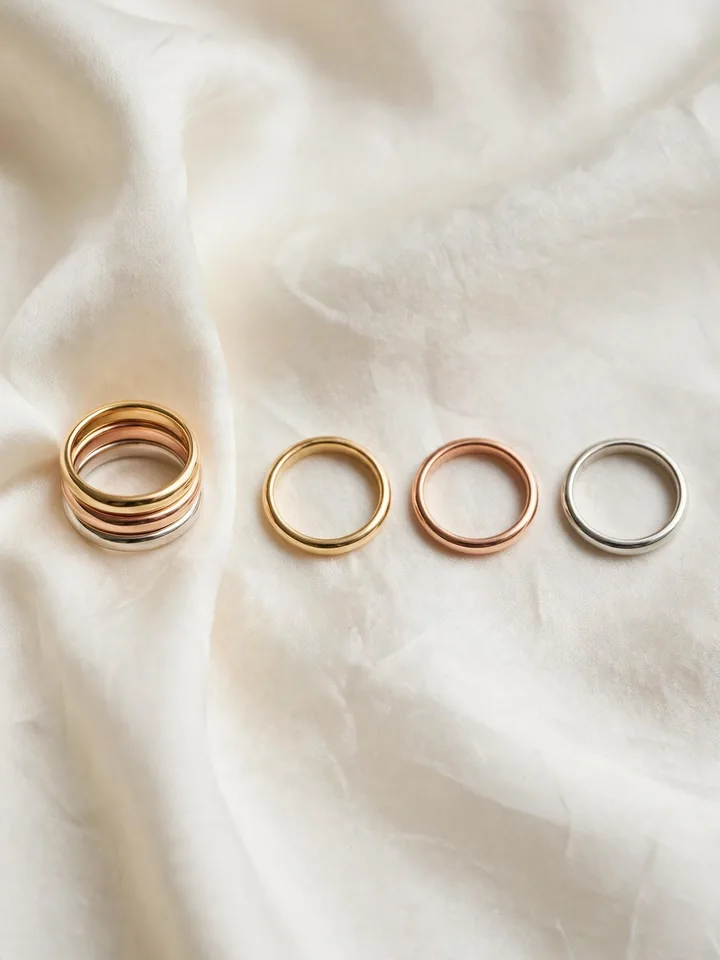
Convertible ring sets are designed to be worn two ways: stacked together as a full mixed metal wedding rings stack, or split across fingers and hands as solo pieces. Each band is finished to look complete on its own — no awkward half-designs that only make sense in formation — which effectively gives you multiple jewellery wardrobes from one purchase.
Look for sets where the bands share a design language but differ in metal and detail: a yellow gold plain band, a rose gold diamond band, a white gold twisted band. Worn together they form a rich, curated stack; worn apart, each is a perfectly respectable standalone ring for travel, work or minimalist days.
Instead of buying separate everyday and occasion rings, one well-designed set covers both. It is the mixed metal wedding rings stack for brides who want options without clutter — jewellery that adapts to the day rather than dictating it.
17. Hidden Halo Engagement Ring in a Mixed Metal Stack
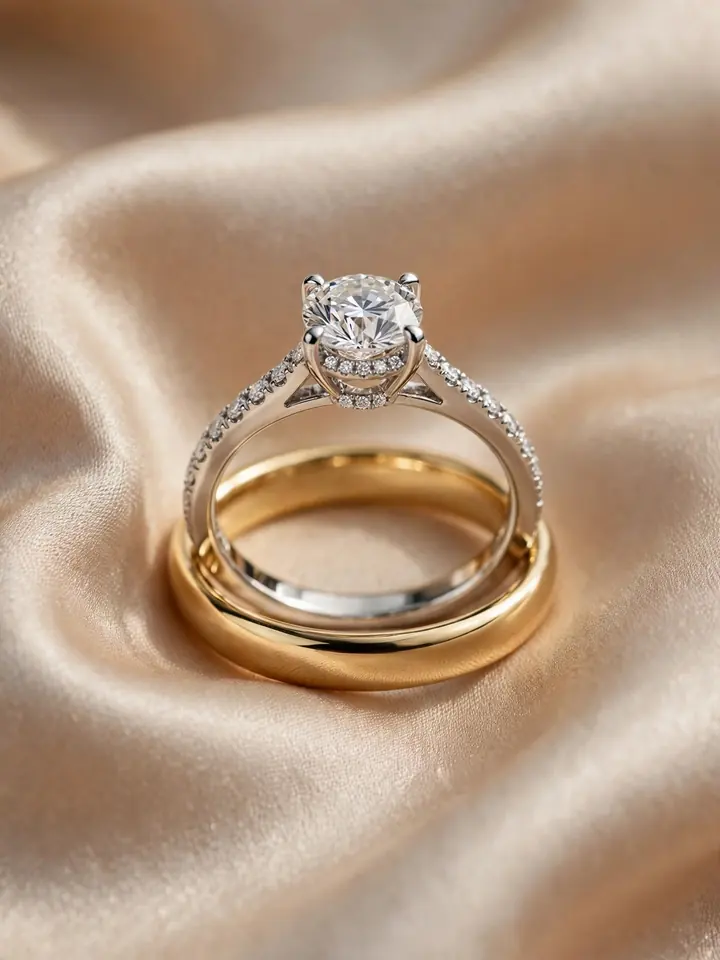
A hidden halo — a ring of small diamonds tucked beneath the centre stone, invisible from above — adds secret sparkle to a mixed metal wedding rings stack. From the top, your solitaire looks classic and understated; from the side, the hidden halo winks between the contrasting metal bands, rewarding a closer look.
The hidden halo also serves a practical purpose in mixed metal stacks: the extra diamond row creates a visual buffer between the engagement ring’s metal and the wedding band’s contrasting metal, making the transition feel deliberate. A white gold hidden halo under a yellow gold solitaire, stacked with a rose gold band, layers three metals and two diamond stories in one finger.
Ask your jeweller to show you the profile view before buying; the hidden halo is the detail that converts a beautiful mixed metal wedding rings stack into an unforgettable one.
18. The Minimalist Curated Three-Band Stack
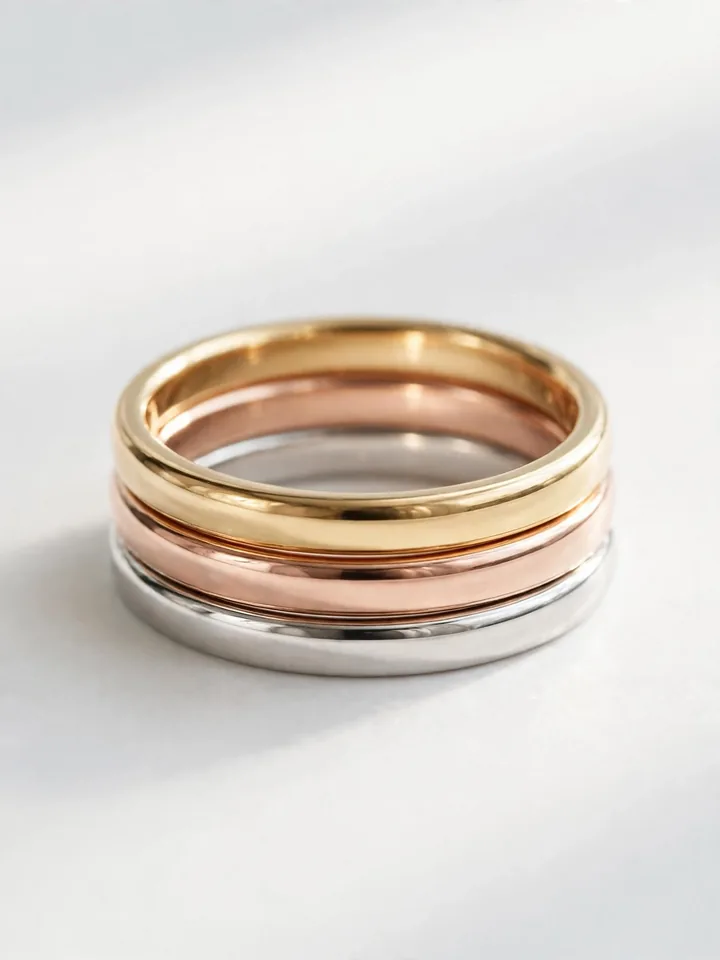
The final idea is restraint itself: three slim, perfectly matched bands — one yellow gold, one rose gold, one white gold — in identical width and finish, stacked with architectural precision. This minimalist mixed metal wedding rings stack proves that mixing metals does not require maximalism; sometimes the most modern statement is quiet confidence.
The key is exactness: same millimetre width, same profile (flat, court or D-shape), same polish level, so the only variable is colour. The result reads like a design object — a study in warm-to-cool gradation that works with everything from a diamond solitaire to a bare finger. It is the stack for brides whose style is clean lines and considered choices.
Of all the mixed metal wedding rings stack ideas here, this is the one you will never tire of: timeless metals, timeless proportions, zero trends to outgrow.
Frequently Asked Questions
Can you mix metals in a wedding ring stack?
Absolutely — mixing metals is one of the biggest modern bridal jewellery trends. A mixed metal wedding rings stack typically combines yellow gold, rose gold and white gold or platinum on one finger. Repeat each metal at least twice and balance warm and cool tones so the combination looks intentional.
What metals go well together in a mixed metal wedding rings stack?
Yellow gold, rose gold and white gold are the classic trio because they share the same karat system and wear similarly. Platinum pairs beautifully with yellow gold for contrast, while rose gold and white gold create a soft romantic blend. Keep finishes consistent for cohesion.
Should my wedding band match my engagement ring metal?
Not necessarily. A contrasting wedding band can make both rings stand out more — a yellow gold band beside a white gold solitaire, for example, highlights each metal’s colour. Many brides now deliberately choose a different metal for the wedding band as the foundation of their mixed metal wedding rings stack.
How many rings should be in a wedding ring stack?
Three to five rings is the sweet spot: an engagement ring plus two to four wedding or anniversary bands. Slim micro-bands can go up to seven, while wide statement bands often look best as a pair. If the stack impedes your knuckle, remove a band.
Will mixed metals damage each other when stacked?
Gold alloys of the same karat wear at similar rates, so yellow, rose and white gold bands stacked together are generally fine. Platinum is harder and can wear neighbouring gold over years, so have your mixed metal wedding rings stack checked and polished by a jeweller once a year.
Final Thoughts
A mixed metal wedding rings stack is more than a trend — it is a philosophy of bridal jewellery that values personality over perfection. Whether you start with the classic three-gold trio, build a narrative of engagement, wedding and anniversary bands, or go bold with blackened accents and geometric chevrons, the 18 ideas above prove there is no single right way to mix your metals. Choose the combination that feels like you, balance warm and cool tones, and wear your story proudly. Pin your favourite mixed metal wedding rings stack ideas to your wedding board, and let your stack evolve with every chapter to come.